11 Bad Habits Sabotaging Your Life (And the Psychology Behind Why They Stick)
11 Bad Habits Sabotaging Your Life (And the Psychology Behind Why They Stick)
The scariest part about destructive habits isn’t when they take over your life. It’s how normal they feel until you wake up and realize they’ve been quietly sabotaging everything you care about.
After researching the psychology behind persistent behavioral patterns, I discovered something counterintuitive. These habits don’t stick around because you’re weak or undisciplined. They persist because they’re solving real psychological problems – just in ways that create bigger problems over time.
Picture this: it’s 11:30 PM and you’re standing in your kitchen again, mindlessly eating chips straight from the bag. Despite promising yourself that morning you were done with late-night snacking for good. The worst part? It wasn’t hunger driving this behavior – it was pure automated response to stress.
The Hidden Truth About Sabotaging Habits:
They don’t announce themselves with warning signs. They sneak in through the back door, meeting real needs in ways that hurt you long-term. Understanding this changes everything about how you approach breaking them.
This connects to the broader framework I researched in my complete guide to breaking unhealthy habits, but today we’re focusing specifically on the psychological mechanisms that make certain habits particularly destructive to your success and wellbeing.
The Psychology of Self-Sabotage: Why Your Brain Works Against You
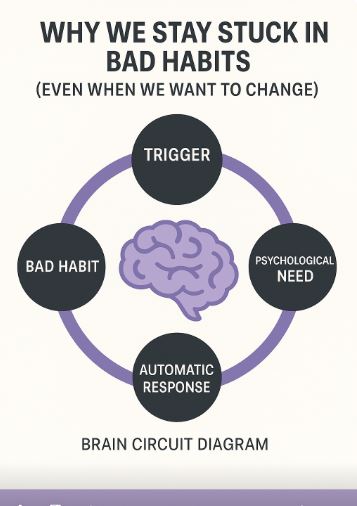 Everything changes when you realize these aren’t character flaws and you’re not a failure. They’re your brain’s confused attempts to help you cope with life’s challenges.
The breakthrough moment comes when you understand that willpower isn’t the answer. These behaviors persist because they’re responses to uncomfortable feelings or unmet needs. Unless you address what’s driving the habit, you’ll keep returning to old patterns.
The Neuroscience Behind Stubborn Habits
NIH research reveals why bad habits feel impossible to break. Parts of our brains actually work against us when we try to overcome these patterns. Dr. Nora Volkow explains that “these routines can become hardwired in our brains,” and the brain’s reward centers keep us craving what we’re trying to resist.
Here’s what happens in your brain: habits operate through a three-part loop stored in the basal ganglia – trigger, routine, reward. Each time you complete this cycle, your brain strengthens the neural pathway. Eventually, the trigger automatically activates the routine before conscious thought kicks in.
When you feel stressed (trigger) and reach for your phone (routine), your brain learns: “Stress → phone scrolling → temporary distraction.” After hundreds of repetitions, this becomes as automatic as breathing.
Why These Habits Sabotage Your Success
Bad habits are particularly destructive because they create feedback loops that compound over time. They don’t just waste your time – they actively undermine your capacity for the behaviors that would improve your life.
- Energy depletion: Managing the consequences of bad habits drains mental resources needed for positive changes
- Identity reinforcement: Repeated patterns shape how you see yourself, making change feel impossible
- Opportunity cost: Time spent on destructive behaviors can’t be spent on growth activities
- Stress amplification: Bad habits often increase the very problems they temporarily solve
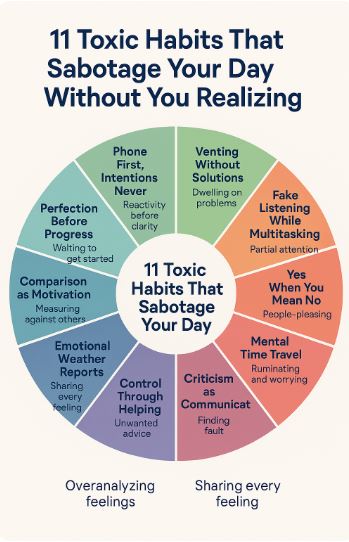
11 Bad Habits That Sabotage Your Life (And Why They Stick)
Let’s examine the specific habits that most effectively undermine success, and the psychological needs driving each pattern:
 1. Endless Social Media Scrolling
The average person spends over 3 hours daily mindlessly consuming content, often through social media and news feeds. This isn’t just time-wasting – it’s life-sabotaging behavior that steals moments of potential connection, creativity, and genuine rest.
What psychological need it serves: This habit meets needs for stimulation, distraction from uncomfortable emotions, and social connection. It provides the illusion of being productive while actually draining mental energy and focus.
How it sabotages your life: Constant content consumption fragments attention, reduces deep thinking capacity, and replaces meaningful activities with passive consumption. It also triggers comparison and anxiety.
Science-Based Solutions:
- Environment design: Create phone-free zones (bedroom, dining table, first hour after waking)
- Replacement rewards: If you scroll when bored, keep books accessible. For connection needs, schedule actual conversations
- Gradual reduction: Use built-in app limits, starting with 25% reduction, then decrease over time
2. Procrastination: The Success Killer
Delaying important tasks until the last minute creates stress cascades that damage work quality and erode self-trust. This ranks among the most sabotaging habits because it prevents progress on meaningful goals.
What psychological need it serves: Procrastination is emotional regulation disguised as laziness. You’re avoiding negative emotions that surface with difficult tasks – boredom, frustration, fear of failure, anxiety about standards.
How it sabotages your life: Creates chronic stress, reduces work quality, breaks down confidence, and prevents achievement of meaningful goals. Each delay reinforces the belief that you can’t be trusted to follow through.
Science-based solutions:
- Emotional awareness: Name the specific emotion that arises when facing avoided tasks
- 5-minute rule: Commit to working just 5 minutes to overcome initial resistance
- Task breakdown: Divide overwhelming projects into smallest possible next steps
3. Sleep Sabotage Patterns
Poor sleep habits create cascading effects throughout life. When you’re exhausted, you become irritable, less productive, more likely to make poor food choices, which then affects sleep the following night.
What psychological need it serves: Staying up late often represents a desire for control and personal time that feels truly yours, especially when days feel overwhelming or not under your control.
How it sabotages your life: Sleep deprivation reduces cognitive function, emotional regulation, immune response, and decision-making capacity. It makes every other area of life more difficult.
Science-based solutions:
- Consistent schedule: Same bedtime and wake time daily, even weekends
- Environmental design: Cool, dark, quiet bedroom free of work materials and devices
- Wind-down ritual: 30-minute pre-sleep routine that signals rest to your brain
4. Negative Self-Talk That Destroys Confidence
The habit of harsh internal criticism becomes so normalized that you barely notice how cruel you are to yourself. This running commentary of judgment shapes mood, confidence, and willingness to take risks.
What psychological need it serves: Negative self-talk often functions as misguided self-motivation or protection against disappointment. Many people unconsciously believe criticism prevents laziness or prepares them for rejection.
How it sabotages your life: Constant self-criticism erodes confidence needed for growth, prevents risk-taking necessary for success, and creates anxiety that interferes with performance.
Science-based solutions:
- Thought monitoring: Build awareness of critical internal dialogue throughout the day
- Friend test: Ask “Would I say this to someone I care about?” If not, rephrase with kindness
- Self-compassion practice: Develop go-to phrases for difficult moments that offer support rather than criticism
5. Chronic Physical Inactivity
Extended sitting and physical inactivity have become normalized despite being unnatural for humans. This habit affects not just physical health but energy levels, mood, brain function, and sleep quality.
What psychological need it serves: Beyond obvious factors like desk jobs, sitting habits continue because movement feels effortful when you’re already depleted. Schedule overload makes exercise seem impossible.
How it sabotages your life: Physical inactivity reduces energy needed for other positive changes, impairs cognitive function, increases depression risk, and creates a downward spiral of decreased capacity.
Science-based solutions:
- Movement snacks: Brief movement moments throughout the day rather than formal workouts
- Joy-based activity: Find movement you genuinely enjoy rather than forcing exercise you hate
- Habit stacking: Attach movement to existing daily routines
6. Mindless Eating While Distracted
Consuming meals while distracted disconnects you from hunger and fullness signals, transforming eating from nourishment into mechanical refueling without awareness.
What psychological need it serves: Mindless eating serves time pressure and discomfort with stillness. Food becomes emotional regulation rather than physical nourishment.
How it sabotages your life: Leads to overeating, digestive issues, weight gain, and disconnection from body signals. Removes one of life’s potential pleasures and replaces it with unconscious consumption.
| Mindless Eating Trigger | Replacement Strategy |
|---|---|
| TV/phone during meals | Create distraction-free eating zone |
| Emotional triggers | 5-bite awareness practice, check hunger levels |
| Time pressure | Schedule designated meal times without rushing |
7. Saying “Yes” When You Mean “No”
The automatic agreement to requests you don’t want creates resentment, burnout, and deep disconnection from your own needs and priorities.
What psychological need it serves: This pattern roots in fear of disapproval and conflict avoidance. Self-worth becomes dependent on being helpful and pleasing others.
How it sabotages your life: Overcommitment prevents focus on meaningful priorities, builds resentment that poisons relationships, and teaches others to disregard your boundaries.
Science-based solutions:
- Decision buffer: Train yourself to say “Let me check my calendar and get back to you”
- Small refusals: Build “no” muscle with low-stakes practice situations
- Script preparation: Prepare kind but clear refusal phrases in advance
8. Information Hoarding Without Action
Constantly consuming books, podcasts, articles, and courses without implementing what you learn creates the illusion of growth while preventing actual progress.
What psychological need it serves: Information hoarding serves perfectionism (“I need to know everything before starting”) and fear of failure. Learning feels productive while avoiding the vulnerability of trying.
How it sabotages your life: Keeps you perpetually preparing instead of progressing, creates analysis paralysis, and substitutes knowledge acquisition for skill development.
9. Chronic Multitasking
Despite overwhelming evidence that humans can’t effectively multitask, this habit persists because it feels productive. It actually fragments attention, increases errors, and raises stress levels.
What psychological need it serves: Multitasking attempts to manage time anxiety and work pressure. It provides the illusion of efficiency and control over overwhelming demands.
How it sabotages your life: Reduces quality of all work, increases mistakes, prevents deep focus needed for complex tasks, and creates chronic stress from constant task-switching.
10. Overthinking and Rumination
Mental time travel – rehearsing future scenarios and reviewing past events – keeps you absent from the present moment where life actually happens, using enormous cognitive resources for minimal benefit.
What psychological need it serves: Overthinking attempts to control uncertainty and prepare for all possible outcomes. It provides the illusion of problem-solving while actually avoiding present-moment challenges.
How it sabotages your life: Drains mental energy, increases anxiety, prevents presence needed for relationships and enjoyment, and creates paralysis around decision-making.
Science-based solutions:
- Scheduled worry time: 15-minute daily period for deliberate concern processing
- Thought defusion: Name the rumination process when caught in it
- Grounding activities: Sensory experiences that return attention to present moment
11. Digital and Physical Clutter
Chronic disorganization – whether chaotic workspace, digital overwhelm, or constant misplacement of items – creates mental stress and drains cognitive resources.
What psychological need it serves: Disorganization often stems from delayed decision-making about where things belong. “I’ll deal with this later” becomes the default response to avoid micro-decisions.
How it sabotages your life: Creates low-level chronic stress, wastes time searching for items, impairs focus in cluttered environments, and reinforces feelings of being out of control.
Science-based solutions:
- One-touch rule: Handle items only once when possible
- Daily reset: 10-minute evening routine returning items to designated places
- Realistic systems: Organize based on actual behavior patterns, not ideals
The Science of Breaking Sabotaging Habits
Research from behavioral scientists like Dr. Wendy Wood reveals that people with the most “self-control” don’t achieve success by exerting control. Instead, they design environments and systems that make good choices easier while addressing the psychological needs driving problematic behaviors.
The Replacement Strategy That Works
Neuroscience shows that trying to eliminate habits creates a vacuum that your brain will fill with something – often the original behavior. The most effective approach involves three steps:
The Three-Step Replacement Process:
- Identify the need: What psychological purpose does this habit serve?
- Find healthy alternatives: What other behaviors could meet the same need?
- Design environmental supports: How can you make the healthy choice easier?
This approach aligns with my research on the Daily Reset Method, which provides a systematic framework for implementing these psychological insights into daily practice.
Why Willpower Fails (And What Works Instead)
Dr. Roy Baumeister’s research shows that self-control operates like a muscle – it gets tired with use. When you’re stressed, tired, or overwhelmed, you automatically fall back on established habits, both good and bad.
This explains why relying on willpower creates the cycle of temporary success followed by relapse. Your executive control systems go “off-grid” precisely when you most need them.
What works instead:
- Environmental design: Remove triggers and barriers rather than resisting them
- Implementation intentions: Pre-planned if-then responses for predictable situations
- Identity shifts: Changing how you see yourself rather than forcing behavioral change
- Need fulfillment: Finding healthier ways to meet the psychological needs driving habits
The Hidden Cost of Sabotaging Habits
These patterns don’t just waste time or create minor inconveniences. They systematically undermine your capacity for the behaviors that would improve your life:
Cognitive Load and Decision Fatigue
Managing the consequences of bad habits consumes mental resources needed for positive changes. When you’re constantly dealing with the aftermath of procrastination, poor sleep, or disorganization, you have less cognitive capacity available for growth activities.
Identity Reinforcement Cycles
Each time you engage in a sabotaging habit, you strengthen the identity that supports it. “I’m someone who procrastinates” becomes a self-fulfilling prophecy that makes change feel impossible.
Compound Effects Over Time
Small daily habits compound exponentially. The person who scrolls their phone for 3 hours daily loses over 1,000 hours per year – time that could be spent on relationships, skills, health, or meaningful projects.
Breaking Free: A Psychology-Based Approach
Understanding the psychological mechanisms behind sabotaging habits changes everything about how you approach breaking them. Instead of fighting against these patterns with willpower, you work with your brain’s natural learning systems.
The Awareness-Action Gap
Most people know which behaviors hurt them but struggle with implementation. This gap exists because they’re addressing surface behaviors without understanding underlying psychological drivers.
Effective change requires addressing both the behavior and the need it serves. When you find healthier ways to meet the same psychological needs, old habits naturally fade.
Environmental Psychology in Practice
Your environment constantly cues behaviors below conscious awareness. Small changes to your surroundings can eliminate the need for willpower:
- Remove triggers: Keep phones out of bedrooms, unhealthy foods out of sight
- Add prompts for good behavior: Place books where you usually scroll, workout clothes by the door
- Design friction: Make bad choices require extra steps, good choices require fewer
FAQ: The Psychology Behind Sabotaging Habits
Q: Why are bad habits so hard to break?
A: Bad habits are hard to break because they become automated responses stored in the brain’s basal ganglia. They serve psychological purposes like stress relief or comfort, and trying to break them with willpower alone fights against deeply ingrained neural pathways.
Q: What psychological needs do bad habits serve?
A: Bad habits typically serve fundamental psychological needs: security, comfort, excitement, connection, control, or emotional regulation. They become problematic when they’re the only way someone has learned to meet these legitimate needs.
Q: How do bad habits sabotage success and wellbeing?
A: Bad habits sabotage life by draining mental energy, reducing productivity, damaging relationships, and preventing progress toward meaningful goals. They create a cycle where temporary relief leads to long-term problems that require more of the same behavior.
Q: Can bad habits be completely eliminated?
A: Rather than elimination, the goal is replacement. Neuroscience shows that first-learned habits remain in the brain even when new ones form. Success comes from strengthening healthier alternatives while addressing the underlying needs the bad habit was meeting.
Q: How long does it take to break a sabotaging habit?
A: Research shows habit change takes 18-254 days depending on complexity, with an average of 66 days. Sabotaging habits often take longer because they serve important psychological functions that must be addressed for lasting change.
From Sabotage to Success: Your Next Steps
Breaking habits that sabotage your life isn’t about becoming perfect or eliminating every negative pattern. It’s about understanding the psychology behind these behaviors and finding healthier ways to meet the same underlying needs.
The journey begins with awareness – recognizing how these patterns operate in your daily life and what purposes they serve. From there, you can apply the environmental design principles and replacement strategies that actually work.
Every time you interrupt an automatic sabotaging pattern and make a conscious choice instead, you’re rewiring neural pathways toward better outcomes. Every moment you notice a habit without judgment, you’re building the awareness that precedes change.
Small changes in how you manage these sabotaging habits create ripple effects throughout your entire life. When you stop wasting mental energy on destructive patterns, that energy becomes available for meaningful growth and achievement.
You’re not broken, and these habits don’t define who you are. They’re learned responses to life’s challenges that can be unlearned and replaced with patterns that serve your actual goals and values.
The psychology is clear: change the environment, address the underlying needs, and provide better alternatives. Your brain will do the rest.
For additional research-based insights on breaking destructive behavioral patterns, explore this comprehensive guide from NIH on the science of habit change.
For more insights, see bad habits really.
Don’t miss hidden danger people pleasing for related tips.
You can also read habits toxic people spot them early for a deeper perspective.