
Toxic Life Patterns: How to Recognize and Break Free
Toxic Life Patterns: How to Recognize and Break Free
Ever wonder why some patterns stick around no matter how hard you fight them? Some people break free from difficult situations while others stay trapped in cycles that drain their energy and keep them feeling frustrated.
You used to be someone who could handle anything life threw at you. Now you struggle with the same problems over and over. Wondering why nothing ever seems to change despite your best efforts.
According to Dr. Nicole LePera, many of our toxic patterns are rooted in unconscious emotional conditioning — and they repeat until we become aware of them. Read her breakdown on how to stop repeating painful life patterns.
Why Toxic Life Patterns Feel Like Just “How Life Is”
Your brain loves patterns because they save mental energy efficiently, yes the human body is wired to save energy and survive at any cost. Once it learns a sequence of thoughts, emotions, and behaviors that work together, it runs that program automatically whenever similar triggers appear in your environment.
This is brilliant for helpful patterns like your morning routine., driving to work without conscious thought. But it’s devastating when the pattern involves self-defeating cycles that keep you stuck in unfulfilling situations.
Take my friend Sarah’s pattern that repeats constantly. She gets excited about new opportunities and throws herself in completely with enthusiasm. Hits the first obstacle or challenge and immediately assumes she’s not cut out for it and quits before giving herself a real chance to succeed.
This cycle has repeated with jobs, relationships, hobbies, health goals. Everything important in her life follows this pattern but she doesn’t see it as a pattern. To her, each situation feels unique and the quitting feels logical given the circumstances she faces. The pattern, or program, actually convinces you that ‘this is how it is’, and gives a long list of reasons.
That’s how toxic life patterns stay invisible to the person living them. Each iteration feels like a reasonable response to current conditions. You don’t notice you’re following a script that guarantees the same disappointing ending.
Your brain treats these familiar cycles as “just how things go” for someone like you. The pattern becomes part of your identity rather than a set of behaviors you could change with effort.
Plus, these cycles often contain some positive elements that make them hard to recognize as problematic. Sarah’s excitement and full commitment are admirable qualities. The issue isn’t her enthusiasm, it’s what happens when challenges arise.
This is why toxic life patterns persist even when they cause obvious pain. The familiar script feels safer than the unknown territory of trying something different.
How Toxic Life Patterns Develop Without Permission
 Most destructive cycles start during times when they actually made sense. Maybe avoiding conflict kept you safe in a chaotic childhood home, perfectionism earned approval from critical parents, people-pleasing prevented abandonment.
Your brain learned something specific through these experiences. “When X happens, do Y to stay safe.” This worked well enough in the original situation that it became your default response to similar feelings or circumstances.
But here’s what’s tricky about toxic life patterns. The situations that created them usually change over time. But the automatic responses remain exactly the same and you keep running software designed for problems you no longer have.
The conflict-avoidance that protected you as a kid now prevents you from standing up for yourself as an adult. The perfectionism that earned parental approval now paralyzes you from starting anything unless you can guarantee perfect results.
These patterns get reinforced over years through repetition. Every time you follow the familiar script, you strengthen the neural pathways. Pathways that make it more likely to happen again.
Eventually, toxic life patterns become so automatic they feel like personality traits, rather than learned behaviors you developed. “I’m just not good with confrontation” or “I’m naturally anxious about new things.” These statements make patterns sound permanent and unchangeable.
But here’s the hopeful truth about this process. If your brain learned these responses, it can learn different ones. The same neuroplasticity that created toxic life patterns can create healthier alternatives.
The challenge is catching yourself in the middle of familiar cycles and choosing different responses. This requires developing awareness of patterns you’ve been running unconsciously for years.
Common Types of Toxic Life Patterns That Keep You Stuck
These cycles show up differently for different people. But they follow predictable sequences that lead to similar disappointing outcomes.
The Perfectionism-Paralysis Cycle
 You set impossibly high standards for yourself in everything. Plan meticulously to avoid any possibility of failure. Get overwhelmed by the pressure you’ve created. Procrastinate to avoid the risk of imperfect results.
Eventually, deadlines force you to rush through work you could have done well with reasonable standards. The rushed results confirm your belief that you need even higher standards next time. The cycle strengthens.
This pattern keeps you safe from criticism but also safe from growth. Safe from recognition and the satisfaction of completing meaningful work. Your toxic life patterns around perfectionism create the very mediocrity you’re trying to avoid.
Healthier alternative: Set “good enough” standards before starting any project. Define what constitutes completion and stick to those standards.
The Chaos-Drama-Rescue Cycle
Life feels boring or too good to be true. You unconsciously create problems, pick fights, or make impulsive decisions that generate crisis and emergency situations. The crisis demands all your attention and energy to solve.
Once resolved, you feel accomplished and needed by others. But also exhausted and confused about why your life always feels chaotic. You don’t connect the dots between your boredom and the subsequent drama.
These toxic life patterns keep you feeling important and busy but prevent you from building stable foundations for long-term happiness.
Healthier alternative: When life feels boring, create positive challenges instead of problems. Take a class, start a project, or set a meaningful goal.
The People-Pleasing-Resentment Cycle
You say yes to everything to avoid disappointing others. Overcommit your time and energy consistently. Feel overwhelmed but don’t ask for help because you don’t want to burden anyone.
Eventually explode in anger or withdraw completely from relationships and feel guilty about your reaction afterward. Apologize and commit to doing better by saying yes to even more. The cycle intensifies over time.
This pattern keeps you feeling needed but prevents authentic relationships where people know and appreciate the real you. Your toxic life patterns around pleasing others actually push them away through inconsistent behavior.
Healthier alternative: Practice saying “Let me check my calendar and get back to you” instead of automatic yes responses.
Why Breaking Toxic Life Patterns Feels Impossible
Most people try to change these cycles through willpower and determination, “this time I’ll dot it” sort of attitude. They recognize a pattern, decide to stop it, and use mental force to choose different behaviors. This works temporarily but rarely creates lasting change.
The reason is that toxic life patterns serve psychological functions. Functions beyond their obvious negative effects. They meet needs for safety, control, identity, or connection. Even when they do it ineffectively.
Your perfectionism protects you from criticism in your mind. Your chaos creation keeps life interesting and engaging. Your people-pleasing ensures you won’t be abandoned by others. Your comparison gives you motivation to improve yourself.
Until you find healthier ways to meet those underlying needs, the old patterns will return whenever stress increases or familiar triggers appear. Plus, these cycles often connect to your sense of identity in ways that make change feel like losing yourself.
“If I’m not the person who has everything together, who am I?” Or “If I don’t put others first, what kind of person does that make me?” Breaking toxic life patterns requires grieving the false self these cycles created, while discovering who you are when you’re not following familiar scripts.
The brain also resists changing established patterns because they represent known quantities. Even painful familiarity feels safer than unknown possibilities that might bring different kinds of pain.
Your nervous system treats pattern changes like threats to survival. Every attempt to break toxic life patterns triggers internal alarms designed to get you back to familiar territory.
This is why change often feels uncomfortable even when you intellectually know it’s good. Good for you, your body hasn’t learned yet that new patterns are safe.
Practical Steps to Break Free from Toxic Life Patterns
Instead of fighting these cycles through force, try working with the underlying needs they’re attempting to meet. Replace destructive patterns with constructive alternatives that serve the same functions, but more effectively.
Step 1: Map Your Personal Patterns
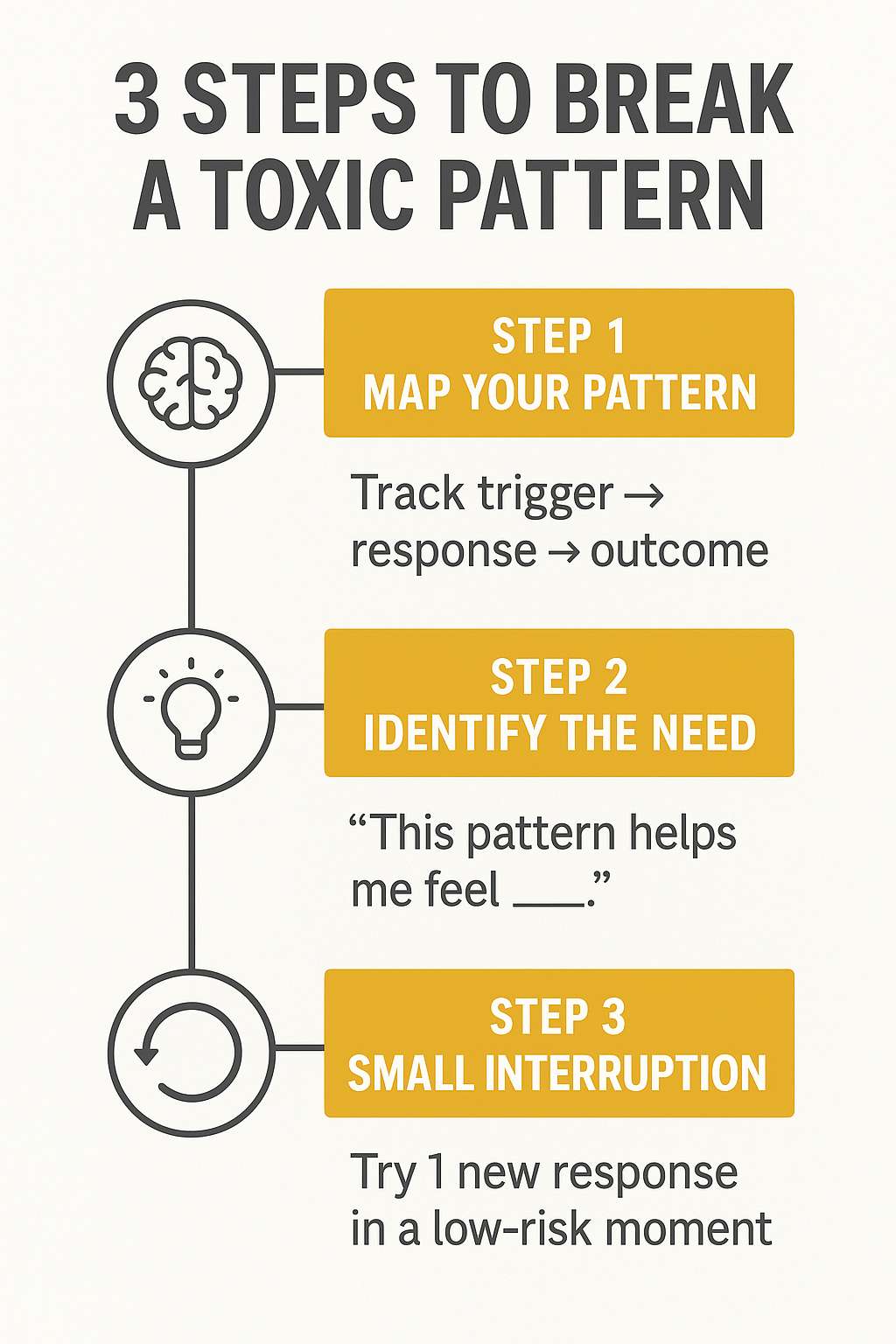 Spend one week noticing when you feel frustrated, disappointed, or stuck. Write down what happened, how you responded, and what outcome occurred. Look for sequences that repeat across different situations.
Don’t try to change anything yet during this observation phase. Just observe how your toxic life patterns operate. Most people are shocked to discover how predictable their responses are.
Notice the emotions that trigger familiar cycles consistently. Boredom often leads to chaos creation, anxiety triggers perfectionism, loneliness activates people-pleasing, fear of rejection starts comparison spirals.
Healthier alternative: Keep a simple pattern journal. Note trigger, response, and outcome for one week without judgment.
Step 2: Identify the Underlying Need
For each pattern you notice, ask what positive intention it’s trying to serve. Your perfectionism wants you to feel valuable. Your control attempts want you to feel safe. Your people-pleasing wants you to feel loved.
Understanding the need behind toxic life patterns helps you approach them with compassion, rather than judgment. These cycles developed to protect you from legitimate fears, like criticism, abandonment, failure, or rejection.
Honor what these patterns were trying to do for you, before attempting to replace them with healthier alternatives.
Healthier alternative: For each pattern, write “This pattern is trying to help me feel ____” and find the underlying need.
Step 3: Experiment with Small Interruptions
Choose one point in your most problematic cycle and try a different response. If you usually research decisions extensively, set a 30-minute limit and then choose. If you typically say yes immediately, try “Let me think about it and get back to you.”
Start with low-stakes situations where the consequences of change feel manageable. Build evidence that different responses are possible before tackling your most entrenched patterns.
Expect discomfort when interrupting toxic life patterns. Your nervous system will signal danger because you’re deviating from known territory. This anxiety doesn’t mean you’re making a mistake, it means you’re changing.
Healthier alternative: Pick the smallest possible interruption first. Build confidence before tackling bigger pattern changes.
Creating New Patterns That Actually Serve You
 Breaking free from toxic life patterns isn’t just about stopping problematic behaviors. It’s about consciously creating new cycles that support your actual goals.
Design replacement patterns that meet the same underlying needs as the old ones, but through healthier methods. If perfectionism provided a sense of value, develop practices for self-appreciation that aren’t tied to performance.
If chaos creation made life feel interesting, find constructive ways to add novelty. And challenge to your routine. If people-pleasing created connection, learn direct communication skills that build authentic relationships.
The new patterns should feel sustainable rather than perfect. Small positive cycles that you can maintain consistently are more powerful. More powerful than dramatic changes that only last a few weeks.
Pay attention to what energizes you versus what drains you. Healthy patterns should generally increase your energy over time.
Remember that creating new patterns takes patience and repetition. Your brain needs time to develop neural pathways that support different responses. Different responses to familiar situations.
But every time you choose a new response over a toxic life pattern, you’re literally rewiring your brain for better outcomes. Small changes compound into significant shifts when maintained consistently over time.
Conclusion
Toxic life patterns aren’t character flaws or permanent features of your personality. They’re learned responses that once served a purpose but now limit your potential for growth and fulfillment.
The good news? The same brain plasticity that created these cycles can create healthier ones when directed consciously and consistently over time.
Breaking free from toxic life patterns requires patience, self-compassion, and willingness to feel temporarily uncomfortable. Uncomfortable as you learn new ways of responding to familiar triggers.
Start by observing one pattern that keeps you stuck. Don’t try to change everything at once. Just notice how the cycle operates and experiment with small interruptions.
Your future self will thank you for every moment you choose growth over comfort. Authenticity over approval, and possibility over the familiar safety of patterns. Patterns that no longer serve you.
The Hidden Pain Behind Toxic Traits: Where They Come From (Part 2)