The Daily Reset Method: A Simple System for Breaking Stubborn Habits
The Daily Reset Method: A Simple System for Breaking Stubborn Habits
Traditional advice for breaking stubborn habits is woefully wrong. It assumes you can willpower your way out of patterns your brain has been practicing for years.
After researching why some people break stubborn habits while others stay trapped in motivation-relapse cycles, I discovered something counterintuitive. The difference isn’t stronger willpower or better character. It’s understanding how to work with your brain’s automatic systems instead of fighting against them.
The Daily Reset Method emerged from this research – a simple 3-step system that addresses the real mechanics of habit formation: environmental triggers, automatic responses, and reward loops.
The Daily Reset Difference:
Instead of fighting your habits with willpower, you redirect them through environmental design and planned responses. This works because habits are learned patterns, not character flaws.
This connects to the broader framework I researched in my complete guide to breaking unhealthy habits, but the Daily Reset Method is the specific systematic approach that makes habit change feel manageable rather than overwhelming.
Why Your Brain Sabotages Habit Change (The Real Problem)
Here’s what nobody tells you about stubborn habits. Your brain isn’t working against you when it defaults to these patterns. It’s actually trying to help by automating responses it believes are useful.
Think about your last attempt to change a habit. Maybe you decided to stop checking your phone first thing in the morning. For a few days, you managed to resist through sheer determination. You felt proud of your self-control.
Then life got stressful. You slept poorly and woke up anxious. Before conscious thought kicked in, your hand was reaching for the phone. The pattern was back, stronger than ever.
The Three-Part Habit Loop
Every habit follows the same structure: trigger → routine → reward. Your brain learns: “Anxiety trigger → phone checking routine → temporary distraction reward.” After hundreds of repetitions, this becomes as automatic as breathing.
Traditional advice focuses only on the middle part – trying to resist the routine through willpower. But your brain is still getting the same anxiety signal and expecting the same relief. You’re fighting against a deeply ingrained neural pathway with nothing but conscious effort.
That’s like trying to stop a river by standing in it. The water will find a way around you.
The Motivation-Relapse Cycle
This explains why most habit change follows a predictable pattern:
- Initial enthusiasm: “This time will be different!”
- Early success: Willpower carries you for 3-7 days
- First trigger: Stress, fatigue, or emotional challenge hits
- Automatic response: Old pattern activates before conscious choice
- Self-criticism: “I’m weak/lazy/have no discipline”
- Renewed promises: “I’ll try harder next time”
The problem isn’t your character. It’s that willpower was never the right tool for the job.
The Daily Reset Method: How It Actually Works
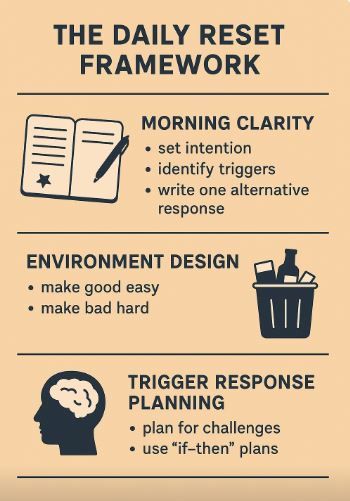
Instead of fighting your brain’s habit-forming tendencies, the Daily Reset Method redirects them. It’s based on three principles that address each part of the habit loop systematically.
Component 1: Morning Intention Setting (5 Minutes)
Most people wake up and immediately react to external demands. Checking notifications before their feet hit the floor. This reactive start primes your brain for autopilot responses all day.
The morning reset creates a conscious buffer between waking and engaging with triggers. Just five minutes of intentional awareness changes how you respond to habit cues throughout the day.
The exact 5-minute process:
Morning Reset Steps:
- Keep journal by bed – pen and paper, not phone apps
- Before any devices – write the habit you’re working on
- Identify today’s triggers – list 2-3 situations that might activate the habit
- Plan one alternative – specific response you’ll try when triggered
- Identity statement – write who you’re becoming (not what you’re avoiding)
This isn’t motivational thinking. You’re literally programming your brain to recognize triggers before they activate automatic responses. When you consciously anticipate challenges, you create mental space to choose differently.
Component 2: Environment Design
Your surroundings shape behavior more powerfully than willpower ever could. Instead of trying to resist temptation through strength, you eliminate temptation through design.
This means creating friction between yourself and harmful habits while removing friction from beneficial alternatives. If you’re trying to stop mindless snacking, don’t keep trigger foods easily accessible. If you’re reducing phone use, don’t charge it by your bed.
Environment changes that work:
| Habit Type | Remove Barriers To | Add Barriers To |
|---|---|---|
| Digital habits | Books, journals, offline activities | Phone apps, notifications, easy access |
| Emotional eating | Healthy snacks, herbal tea, fruit | Processed foods, trigger snacks |
| Procrastination | Work materials, focused workspace | Distracting websites, social media |
| Negative thinking | Gratitude journal, positive reminders | Negative news, toxic social feeds |
The key insight: your environment constantly cues behaviors below conscious awareness. When you become intentional about these cues, you gain enormous leverage over your actions without relying on moment-to-moment willpower.
Component 3: Response Planning
Most habit relapses happen in predictable situations – when you’re stressed, bored, tired, or facing specific emotional triggers. Instead of hoping you’ll make good decisions in these moments, you prepare responses ahead of time.
This uses implementation intentions – specific if-then statements that create mental shortcuts faster than old habits. When you pre-decide responses to triggers, you bypass the need for willpower entirely.
How to create effective if-then plans:
- Identify high-risk scenarios – specific times, places, and emotional states
- Create detailed if-then statements – not vague promises but specific actions
- Make them concrete – “If I feel stressed after work, then I will take three deep breaths and walk outside for 5 minutes before deciding what to do next”
- Rehearse mentally – visualize using these plans when you’re calm
The Complete Daily Reset System For Breaking Stubborn Habits
Here’s how all three components work together to create lasting habit change:
Week 1-2: Foundation Building
Focus: Establish the morning reset routine before worrying about perfect habit execution.
Daily actions:
- 5-minute morning intention setting (no exceptions)
- One environment change per week
- Create 2-3 if-then plans for your biggest triggers
- Track consistency with the reset, not habit perfection
Week 3-4: Pattern Recognition
Focus: Notice triggers and automatic responses without judgment.
What to expect: You’ll catch yourself mid-habit more often. This awareness feels frustrating but is actually progress. Your brain is learning to recognize triggers before full activation.
Month 2: Inconsistent Success
Focus: Use your if-then plans when you remember, recover quickly when you don’t.
Key insight: Success isn’t measured by perfect execution but by recovery speed after setbacks. How quickly do you return to your morning reset practice?
Month 3+: Pattern Stabilization
Focus: Alternative responses start feeling natural rather than forced.
Signs of progress: Old habit urges become less intense and frequent. Your planned responses activate more automatically. Environmental changes feel normal rather than restrictive.
Adapting the Method for Specific Habits
While the three-component framework applies universally, different habits need tailored strategies:
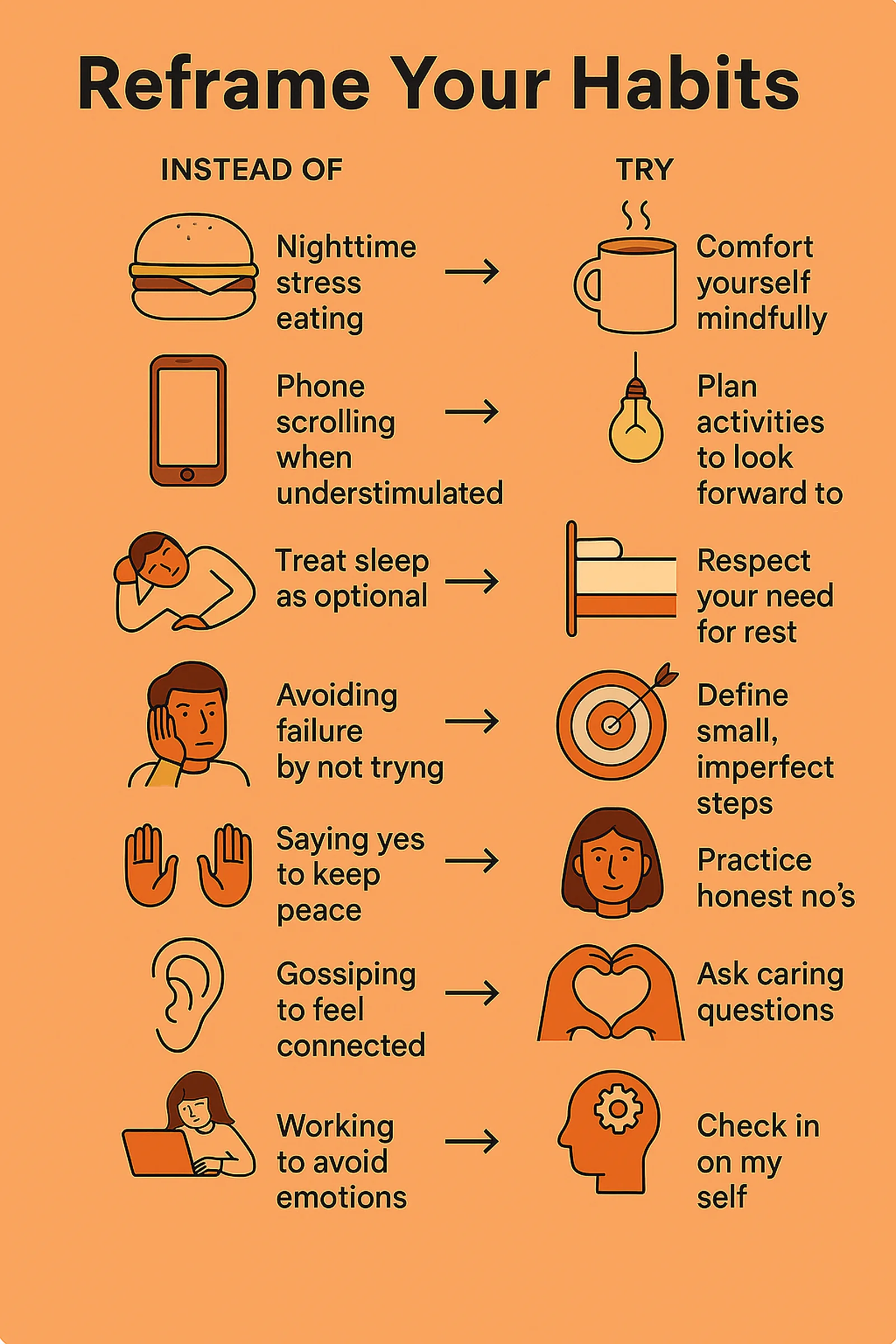
Digital Addiction and Phone Habits
These devices are engineered to capture attention through variable reward schedules – the same psychology that makes slot machines addictive.
Morning reset focus: Set specific technology boundaries rather than vague “use less” goals. “No phone for first hour after waking” or “phone stays in kitchen during meals.”
Environment design: Physical separation works better than mental resistance. Analog alarm clock, phone charges in another room, app blockers during vulnerable hours.
Response planning: “If I feel bored and reach for my phone, then I will first take one deep breath and ask myself what I actually need right now.”
Emotional Eating Patterns
Food habits are complex because eating is survival-necessary, and food becomes connected with comfort, celebration, and emotional regulation.
Morning reset focus: Identify emotional states that trigger problem eating, not just the foods themselves. Plan non-food comfort measures.
Environment design: Make mindless eating harder and mindful eating easier. Healthy snacks at eye level, trigger foods in opaque containers or inconvenient locations.
Response planning: “If I feel overwhelmed after work, then I will play music and do dishes for 10 minutes before entering the kitchen to eat.”
Procrastination and Avoidance
Procrastination isn’t time management – it’s emotional management. You delay tasks because starting triggers uncomfortable feelings like inadequacy or fear of failure.
Morning reset focus: Identify the specific emotional discomfort underlying avoidance. What are you actually afraid will happen?
Environment design: Dedicated workspaces with minimal distractions. Time-blocking to make overwhelming tasks feel manageable.
Response planning: “If I feel resistance to starting work, then I will set a timer for 5 minutes and begin with the easiest part of the task.”
The Science Behind Why This Works
The Daily Reset Method isn’t based on positive thinking or motivation. It’s grounded in neuroscience research about how habits actually form and change.
Leverages Implementation Intentions
Dr. Peter Gollwitzer’s research consistently shows that people who use specific if-then plans are 2-3 times more likely to follow through compared to those relying on general goals or motivation.
When you pre-decide responses to triggers, you create mental shortcuts that activate faster than old habit pathways.
Works With Reward Systems
Bad habits persist because they provide real rewards – stress relief, entertainment, social connection. Simply eliminating rewards creates deprivation, which strengthens the original habit.
The Daily Reset Method redirects your reward system toward healthier patterns rather than fighting it. You’re not eliminating the need for stress relief; you’re finding better ways to meet that need.
Builds Metacognitive Awareness
The morning intention practice develops what researchers call metacognitive awareness – the ability to observe your own thinking and behavior patterns.
When you spend five minutes each morning anticipating triggers, you’re training your brain to recognize these situations before they activate automatic responses.
Your Daily Reset Checklist (Free Download)
Daily Reset Method Checklist
Morning Intention (5 minutes):
- □ Wrote down habit I’m working on
- □ Identified 2-3 potential triggers for today
- □ Planned one alternative response
- □ Wrote identity statement about who I’m becoming
Environment Check:
- □ Barriers removed from healthy choices
- □ Barriers added to harmful choices
- □ Physical space supports my goals
Response Planning:
- □ Created specific if-then plans for high-risk situations
- □ Plans include exact actions, not vague promises
- □ Rehearsed mentally when calm
Daily Practice:
- □ Used planned response when triggered (or noticed trigger)
- □ Recovered quickly from any setbacks
- □ Focused on progress, not perfection
Common Challenges and Troubleshooting
Even with a solid system, specific obstacles tend to arise. Here’s how to navigate the most frequent challenges:
“I Keep Forgetting the Morning Reset”
Your brain wants to maintain existing morning patterns. Checking phones or rushing into the day feels more urgent than intentional planning.
Solution: Attach the reset to something you already do consistently. Put your journal next to your coffee maker, toothbrush, or wherever you naturally go each morning.
“My Triggers Feel Too Powerful to Resist”
Some habits connect to intense emotional or physical triggers that seem impossible to redirect in the moment.
Solution: Focus more heavily on environment design. If stress eating feels uncontrollable, remove trigger foods entirely rather than trying to resist them. If phone checking feels automatic, create physical barriers during vulnerable times.
“I Do Well Then Completely Fall Back”
All-or-nothing thinking leads to abandoning the entire system after one slip-up.
Solution: Expect setbacks and plan for them. When you slip into old patterns, immediately return to your morning reset practice rather than waiting for Monday or next month to “start over.” Progress isn’t linear.
“The Changes Feel Too Small to Matter”
Five minutes of morning intention-setting can feel insignificant compared to habits you’ve had for years.
Solution: Small changes compound exponentially over time. A tiny change practiced daily for six months creates more transformation than dramatic changes attempted for a few days. Focus on consistency over intensity.
FAQ: What People Ask About the Daily Reset Method
Q: What is the Daily Reset Method?
A: The Daily Reset Method is a 3-step system for breaking stubborn habits: Morning Intention (5-minute awareness practice), Environment Design (removing triggers and barriers), and Response Planning (preparing alternatives for trigger moments). It works with your brain’s natural patterns rather than relying on willpower.
Q: How long does the Daily Reset Method take each day?
A: The daily component takes just 5 minutes each morning for intention setting. Environment design is a one-time setup of your spaces. Response planning involves creating if-then statements that activate automatically when triggers occur.
Q: Does the Daily Reset Method work for all types of habits?
A: The framework applies to most behavioral habits – digital addiction, emotional eating, procrastination, negative thinking patterns. However, habits involving substances or causing significant distress may require professional support alongside this method.
Q: Why do other habit-breaking methods fail while this one works?
A: Traditional methods rely on willpower and motivation, but habits operate automatically below conscious awareness. The Daily Reset Method addresses the actual habit loop – environmental triggers, automatic routines, and reward systems – rather than fighting brain patterns with force.
Q: What should I do if I miss several days of the morning reset?
A: Simply resume immediately without self-criticism. Missing days doesn’t erase your progress – the neural pathways you’ve been building remain. The key is overall consistency over time, not perfect daily adherence.
When Professional Support Is Needed
The Daily Reset Method effectively addresses most behavioral habits, but certain situations benefit from additional professional guidance:
- Habits involving substances (alcohol, drugs, prescription medications)
- Behaviors causing significant distress or interfering with daily functioning
- Patterns connected to trauma, anxiety, depression, or other mental health conditions
- Habits with dangerous health or safety consequences
Mental health professionals can provide specialized approaches that complement the Daily Reset Method. Seeking support demonstrates wisdom, not weakness.
Beyond Habit Change: What You’re Really Building
The Daily Reset Method does more than break individual habits. It develops a different relationship with your automatic patterns and unconscious behaviors.
Every morning you spend five minutes setting intention, you strengthen awareness over reactivity. Every time you use an if-then plan instead of defaulting to old patterns, you build confidence in your ability to choose responses rather than just react to triggers.
These skills extend far beyond specific habit change. You’re developing what researchers call “cognitive flexibility” – the ability to adapt your thinking and behavior to changing circumstances.
This connects to my broader research on the 7 practical steps for breaking bad habits, where I explore additional strategies that complement the Daily Reset Method for comprehensive habit transformation.
Small daily resets, practiced consistently over time, create profound changes that ripple through every area of life. You’re not just breaking problematic patterns – you’re reclaiming conscious choice over automatic responses.
The method works because it honors how your brain actually functions rather than fighting against it. When you align your habit change efforts with your neural architecture instead of opposing it, transformation becomes inevitable rather than effortful.
For additional evidence-based strategies on behavioral change, explore this comprehensive guide from Mayo Clinic on creating lasting habits.
Learn more in overthinking toxic mind stop.
For a detailed guide, check out stop sadfishing get real support.
For more insights, see stop doomscrolling mental health.