Automatic Behaviors: The Psychology Behind Your Brain’s Autopilot
Automatic Behaviors: The Psychology Behind Your Brain’s Autopilot
Have you ever wondered why you reach for your phone the second you sit down? Or why you automatically open the fridge when you walk into the kitchen, even when you’re not hungry?
I’ve been fascinated by this stuff for months now, and what I’ve discovered is pretty mind-blowing. Your brain has been quietly programming automatic behaviors without you realizing it. Every single day, you’re running on psychological autopilot more than you think.
What Automatic Behaviors Actually Are
Automatic behaviors are learned responses that your brain executes without conscious thought. They’re not random habits – they’re sophisticated psychological programs your environment has been installing in your mind, one repetition at a time.
Think about it. You don’t consciously decide to check your phone when you hear a notification. You don’t deliberately choose to grab snacks when you’re stressed. These responses happen automatically because your brain has learned to connect specific triggers with specific actions.
Here’s what most people don’t realize: every automatic behavior follows the same basic psychology. There’s a trigger (psychologists call it a “cue”), an automatic response, and some kind of reward your brain gets from it. Your brain learns this pattern so well that the trigger starts the behavior before your conscious mind even notices.
This isn’t about willpower or self-control. It’s about understanding how your brain’s automatic programming actually works.
The Three-Part Automatic Response System
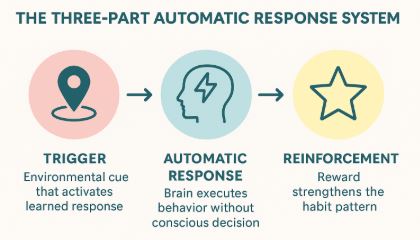 Every automatic behavior operates through what researchers call the “habit loop” – but I think of it as your brain’s automatic response system.
Trigger: Something in your environment activates the learned response. Could be a location, time of day, emotion, or sensory cue.
Automatic Response: Your brain executes the learned behavior without conscious decision-making. This happens faster than rational thought.
Reinforcement: Your brain gets some kind of reward – dopamine release, stress relief, social connection, entertainment – that strengthens the automatic pattern.
What’s fascinating is how precise these triggers become. I started tracking my own automatic behaviors, and I was shocked at how specific they were. Sitting in a particular chair triggered phone scrolling. Walking past the kitchen triggered snacking. Feeling overwhelmed triggered social media checking.
Your brain creates incredibly detailed mental maps linking triggers to automatic responses. The more you repeat the pattern, the stronger and faster the automatic behavior becomes.
How Your Environment Programs Automatic Behaviors
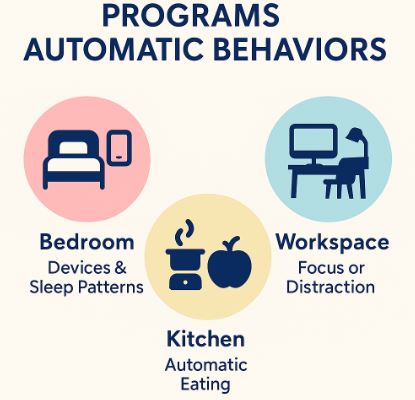 Ever notice how certain spaces immediately trigger specific automatic behaviors? That’s environmental conditioning in action. Your brain associates physical locations with learned responses so strongly that just being in the space can activate autopilot mode.
Your bedroom conditions automatic behaviors around sleep and devices. If you consistently use your phone in bed, your brain learns: bedroom equals screen time. The physical space becomes a behavioral trigger. Sleep experts understand this – that’s why they’re obsessed with keeping bedrooms device-free.
Your kitchen triggers automatic eating responses. Not because you’re hungry, but because you’ve trained your brain to associate that space with food consumption. Every time you walk through and grab something “just because,” you strengthen that automatic pathway.
Your workspace conditions focus patterns. If you consistently multitask or check notifications while working, you’ve programmed your attention to automatically fragment. The environment itself becomes a trigger for scattered focus.
I keep hearing the same story from people: they feel completely out of control in certain spaces. But they’re not broken – they’re displaying perfectly predictable automatic responses to environmental triggers they’ve learned over time.
The Speed of Automatic Responses
Research shows that automatic behaviors happen faster than conscious decision-making. Way faster. We’re talking milliseconds between trigger and response, while conscious thought takes several seconds to kick in.
This explains why automatic behaviors feel so powerful. By the time your rational mind notices what’s happening, your brain has already initiated the learned response. You’re not fighting against weak willpower – you’re trying to override high-speed psychological programming.
Someone mentioned this to me recently: their phone checking feels “hypnotic.” That’s actually the perfect description. Automatic behaviors often operate below conscious awareness. You respond to triggers your rational mind doesn’t even register.
Common Automatic Behaviors and Their Triggers
Let me break down some widespread automatic behavior patterns I keep observing:
Digital Automatic Responses
Triggers: Notification sounds, phone visibility, boredom, specific apps, certain times of day
Automatic Response: Immediate attention shift, compulsive checking, mindless scrolling
Brain Reward: Social validation, new information, temporary escape from uncomfortable emotions
This automatic behavior is incredibly sophisticated. Tech companies employ behavioral psychologists specifically to create what researchers call “variable reinforcement schedules.” You never know when you’ll get rewarded (new message, interesting content), which actually programs the automatic response faster than predictable rewards would.
Every notification sound is essentially training your brain. Sound equals potential reward. Check immediately. Over time, even seeing the device can trigger the automatic response. That’s what psychologists call “stimulus generalization” – when automatic behaviors spread to related triggers.
Automatic Eating Responses
Triggers: Specific emotions (stress, sadness, boredom), certain times, particular locations, food visibility
Automatic Response: Reaching for specific comfort foods without conscious hunger
Brain Reward: Temporary emotional relief, chemical reward from sugar/fat combination
I’ve noticed that automatic eating often follows incredibly precise trigger patterns. Certain emotions become paired with specific food responses through repeated association. Stress triggers sugar cravings. Loneliness triggers high-fat foods. Anxiety triggers crunchy textures.
The automatic response becomes so specific that people often can’t explain their cravings rationally. They’re not making conscious food choices – they’re displaying learned responses to emotional triggers.
Avoidance Automatic Behaviors
Triggers: Tasks associated with past negative experiences, certain emotions, overwhelming situations
Automatic Response: Postponement, distraction-seeking, task switching
Brain Reward: Immediate relief from anxiety or discomfort
Procrastination is actually an automatic avoidance response. The behavior (avoiding the task) gets strengthened because it removes something unpleasant (anxiety about starting). Your brain learns: avoidance equals relief. Keep avoiding automatically.
What’s fascinating is how this automatic response can generalize. If you have a negative experience with one type of task, your brain might start automatically avoiding similar tasks. Or tasks that happen in the same environment. Or tasks that trigger the same emotional state.
The Neuroscience Behind Automatic Behaviors
Understanding how your brain creates automatic behaviors helps explain why they feel so powerful and why changing them requires specific strategies.
Habit Brain vs. Decision Brain
Your brain has different systems for automatic behaviors versus deliberate choices. Automatic behaviors get stored in areas that operate with minimal conscious input – that’s why they feel like they’re “just happening” to you.
Research shows that automatic behaviors actually require less brain energy than conscious decision-making. This explains why they feel “easier” and why overriding them with conscious choice requires sustained mental effort.
Your brain prefers automatic responses because they’re energy-efficient. From your brain’s perspective, automatic behaviors are successful solutions to recurring situations. Why waste energy on conscious decision-making when the automatic response works?
How Automatic Behaviors Strengthen Over Time
Every time you complete an automatic behavior cycle, your brain strengthens the neural pathway between trigger and response. Neuroscientists call this “potentiation” – the connection literally becomes more powerful with repetition.
This explains why automatic behaviors feel increasingly compelling over time. It’s not psychological weakness. Your brain has been systematically reinforcing the trigger-response connection until it operates faster than conscious thought.
I keep seeing people blame themselves for automatic behaviors that have been years in the making. But you can’t willpower your way out of learned neural pathways that your brain has been strengthening for months or years.
Neuroplasticity: Why Change Is Possible
The good news? Your brain can form new automatic pathways throughout your life. No automatic behavior is permanently wired. Changing established patterns requires consistent practice over weeks to months, but it’s absolutely possible.
Research from the National Institute of Mental Health shows that behavioral change literally rewires neural pathways through sustained practice of new responses to familiar triggers.
Changing Automatic Behaviors: Working With Your Brain’s Programming
Once you understand how automatic behaviors work, you have multiple intervention points. You don’t have to rely on willpower alone – you can work with your brain’s natural programming instead of against it.
Trigger Modification
Change the environmental cues that activate automatic responses. This is often the most effective intervention point because it prevents the learned response from getting triggered in the first place.
Keep your phone in a different room. Rearrange your living space. Change your routines. Small environmental modifications can interrupt automatic behavior patterns that have been building for years.
I started keeping a simple trigger journal. Every time I noticed an automatic behavior, I wrote down what happened right before it. After a week, the patterns became obvious. The same environmental cues kept triggering the same automatic responses.
Response Interruption and Substitution
Instead of trying to eliminate an automatic response, interrupt it and substitute a different one. This works because you’re using the existing trigger-response pathway but changing the end behavior.
When you feel the urge to check your phone, do five pushups instead. When stress triggers eating, try three deep breaths first. You’re not fighting the automatic trigger – you’re redirecting the response.
This technique works because it acknowledges that learned triggers will still happen. You’re just training a new automatic response to the same environmental cue.
Conscious Override Training
Practice noticing automatic behaviors as they start, then deliberately choosing a different response. This builds what researchers call “cognitive flexibility” – your ability to consciously override automatic programming.
The key is catching the automatic response early in the cycle. Once the behavior is fully activated, conscious override becomes much harder. But if you can notice the trigger and pause before the automatic response kicks in, you create space for conscious choice.
The Timeline for Automatic Behavior Change
 Changing automatic behaviors follows predictable stages that research has mapped out:
Days 1-7: High conscious effort required. Old triggers still activate automatic responses, but you can interrupt them with deliberate attention. Expect this to feel exhausting.
Days 8-21: New responses start feeling slightly more natural. Old automatic behaviors still kick in frequently, but recovery happens faster. You might notice triggers without immediately responding.
Days 22-45: Competing automatic behaviors. Sometimes the new response feels automatic, sometimes the old pattern takes over. This inconsistency is normal and expected.
Days 46-90: New automatic behaviors strengthen. Environmental triggers increasingly activate desired responses instead of old ones. Setbacks happen but recovery is quicker.
Beyond 90 days: New patterns become reliably automatic. Old triggers may still occasionally activate previous responses, but the new automatic behavior is stronger.
This timeline varies based on how long the original automatic behavior was established and how consistently you practice the new response.
Practical Tools for Automatic Behavior Awareness
Here are the most effective techniques I’ve found for becoming conscious of your automatic behavior patterns:
Trigger Tracking: For one week, note every automatic behavior and what happened right before it. Look for patterns across multiple instances. This reveals your specific trigger-response programming.
Environmental Audit: Walk through your daily spaces and identify automatic behavior triggers. What environmental cues consistently activate unwanted responses? What changes would interrupt these patterns?
Pause Practice: When you notice an automatic behavior starting, pause for three seconds before continuing. This builds awareness of the trigger-response cycle and creates space for conscious choice.
Alternative Planning: For each automatic behavior you want to change, design a specific substitute response to the same trigger. If stress triggers phone checking, plan to do breathing exercises instead.
For Anyone Currently Struggling With Automatic Behaviors
Your automatic behaviors aren’t character flaws or signs of weakness. They’re learned responses that your brain developed to solve problems – even if the solutions aren’t serving you well anymore.
Every automatic behavior originally served some purpose. That phone checking? It provided connection or escape from boredom. The stress eating? It offered comfort when everything felt overwhelming. The work avoidance? It protected you from anxiety or potential failure.
The key is understanding what need your automatic behaviors are trying to meet, then finding healthier ways to meet that same need.
Every time you notice an automatic behavior without judgment, you create awareness. Every time you interrupt an old pattern, you weaken that neural pathway. Every time you practice a new response, you strengthen alternative automatic programming.
The path isn’t about becoming perfect or eliminating all automatic behaviors – many of them serve you well. It’s about becoming conscious of your brain’s programming and deliberately shaping the automatic responses that guide your daily experience.
Which automatic behaviors have you noticed in your own life? What environmental triggers seem to activate your strongest autopilot responses?
For a deeper understanding of how these patterns develop and strengthen over time, check out my comprehensive research on the psychology behind ingrained behavioral cycles.
You can also read unhealthy behaviors explained for a deeper perspective.